Sharon Lynn Fisher: Small Magic, Ancient Power
On curiosity and the hidden power in stories we consider cozy

There's something I love about browsing a bookstore with no agenda — just letting covers beckon, seeing what calls to you the way a flower in a garden catches your eye before you know why. That's how I found Sharon Lynn Fisher. Tea & Alchemy — the title, the cover, the promise of something I didn't know I was looking for. Within a week I'd devoured all three of her cozy gothic romances back to back, with a hunger that told me these stories were working on something in me I hadn't quite named yet.
What I found across all three books was a pattern. A woman walks into an inherited mess — family curses, buried secrets, systems built on what the previous generation refused to face — and instead of fighting it head-on, she stays curious. She reads the tea leaves. She opens the forbidden book. She asks the question no one wants asked. And through these small, embodied, persistent acts, something ancient and poisonous starts to shift.
I want to talk about what that shift actually is. Because I don't think it's metaphor. Or at least, it's not only metaphor.
There's a word I keep coming back to: metabolize. Not resist — resistance keeps you locked in the same system, pushing against a force that feeds on your pushing. Not escape — escape just postpones the encounter. Metabolize. The way a body breaks down what it's taken in and transforms it into something the system can actually use. It requires slowing down. It requires presence. It requires staying with something uncomfortable long enough for it to change form.
And it requires a catalyst.
In Sharon's books, that catalyst is curiosity. Her heroines carry it like a birthright — this refusal to stop at the locked door, to accept the surface story, to let the family secret stay sealed. Curiosity is the enzyme that breaks down the old pattern. Without it, the inherited curse just keeps cycling — generation to generation, the same wound in new clothes. But when someone walks in and starts asking what nobody wants asked, the whole system has to respond. What was sealed begins to open. What was poisoning the bloodline begins — slowly, not all at once — to transform.
This is not a small thing, though it looks like one.
Years of working as an archetypal astrologer and vocational coach have taught me to listen not just to what's being said but to the images underneath — and especially to what gets dismissed as unimportant. So when I read a cozy gothic romance where a woman breaks a generational curse by making tea and asking questions, I can't just enjoy the story and move on. I see something working beneath the surface. Something that looks like entertainment but functions like medicine.
Because I think this is what the best romance novels are quietly doing for their readers. When you pick up a book at the end of a day that's flattened you — when the news is unbearable and the anxiety is humming and you can't face one more serious thing — and you enter a story where inherited wounds get traced to their source, where someone's persistent gentleness turns out to be the most powerful force in the room — you are not escaping. You are crossing a threshold into the imaginal, into a space where something can be worked on that your coping, managing, getting-through-the-day mind cannot touch. The story does the work. Your body softens. Your imagination opens. And something metabolizes — not just for you, but through you.
We don't talk about this enough. The romance novel gets dismissed as fluff, as guilty pleasure, as something to consume and forget. And I understand why — it's easy to see the surface and stop there. But the surface is not the story. It never has been. And in times like these — when so much is loud, when fear wants all of our attention, when everything is being flattened into simple answers — the quiet act of entering a story and letting it work on you might be more powerful than we know.
Stories are thresholds. Readers are crossing them every night. And what happens on the other side — in the quiet, in the imaginal, in the body of a reader curled up with tea and a book that the world says doesn't count — is medicine the loud world doesn't know how to measure but desperately needs.
Guest Bio:
Sharon Lynn Fisher writes mash-ups of fantasy, mystery, and slow-burn romance set in lush and atmospheric worlds. Her current series of stand-alone novels (which began with Salt & Broom) features cozy gothic fantasies set in Victorian England.
Sharon's other books include Grimm Curiosities, Tea & Alchemy, the Faery Rehistory historical romantasy series, and a trio of science fiction romances. Sharon is an Amazon bestselling author.
Sharon has always loved speculative romance because the reader gets to follow would-be lovers to a place where the rules are different, stakes are high, and every plot twist triggers a fresh sense of wonder.
When she’s not writing, you'll mostly find her wandering the Pacific Northwest woods looking for fairies and mushrooms.
For more on her books, visit her website here.
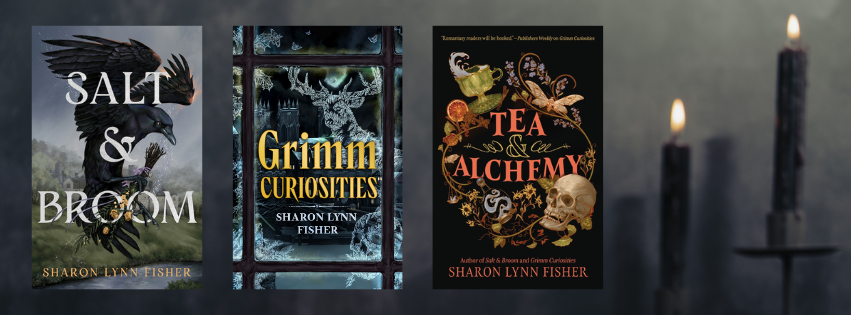
My full reviews of Sharon's books on Goodreads: Tea & Alchemy Grimm Curiosities Salt & Broom