
Approach
Reading is the work.

I do not mean reading in one sense only.
Reading is what we do with the news, with data, with a friend's mood, with weather patterns, with a body that is asking for something, with a chart, with a book.
Reading is an approach to noticing.
It is how we watch a life unfurl in front of us and learn to see the patterns underneath.
Done well, it is observant and participatory at once.
The approach I take is to read at three layers, every time.
Whether the text in front of me is a romance novel, a birth chart with its transits, or the story a client is telling me at the kitchen table of a threshold she may not yet know she is in.
I read for what is being dismissed.
Where culture, or a person, has called something silly, small, or not worth taking seriously, that is most often where the gold has gone. The depth too. The insight. Sometimes the healing.
Much of the work is going back to the dismissed places and seeing what is actually there.
That is why I love stories.
Not only the ones people read, but the ones they tell about themselves.
How someone speaks to how she got to where she is and how she speaks about the threshold she is in.
Sometimes she does not yet know she is in one.
Then I listen to what is said and to what is not said, to the images and metaphors she reaches for without thinking, because those carry the map.

The Threshold Territory
Most reading stays at one level. The plot. The prediction. The diagnosis. I read at three because the medicine of a text lives at every layer, and the layer most often missed is the one that matters most.
Pleasure is the first layer, and desire is its compass.
What pulled you here? What in the trope, the chart placement, the moment of the story made something in you say yes? Pleasure is information. Desire is a compass. The body knows before the mind catches up. What you are drawn to is already telling you where the medicine lives. Whatever brought you to the text is the first thing I want to honor.
The personal layer is about integration, not consumption.
What is this story doing for the person reading it? What is this chart asking of the person who carries it? What is being reflected, processed, longed for, refused? Reading at the personal layer is not collecting insights to file away. It is digestion. What you take in changes you if you let it sit long enough to be metabolized. The personal layer is where the story becomes a mirror.
The collective layer is where you stop being alone in it.
What is this story saying about the culture we are reading from the inside? What is the genre doing for women right now? What is the chart placement asking of the generation it belongs to? Nothing happens in the vacuum of isolated individuality. As above, so below. As within, so without. And as without, so within. The collective is where what you carry shows up to be carried with you. Where the medicine multiplies because the field is reading too.
Three layers, one practice.
The same way of reading whether I am holding a romance novel, a Saturn return, or a client at the end of a marriage.
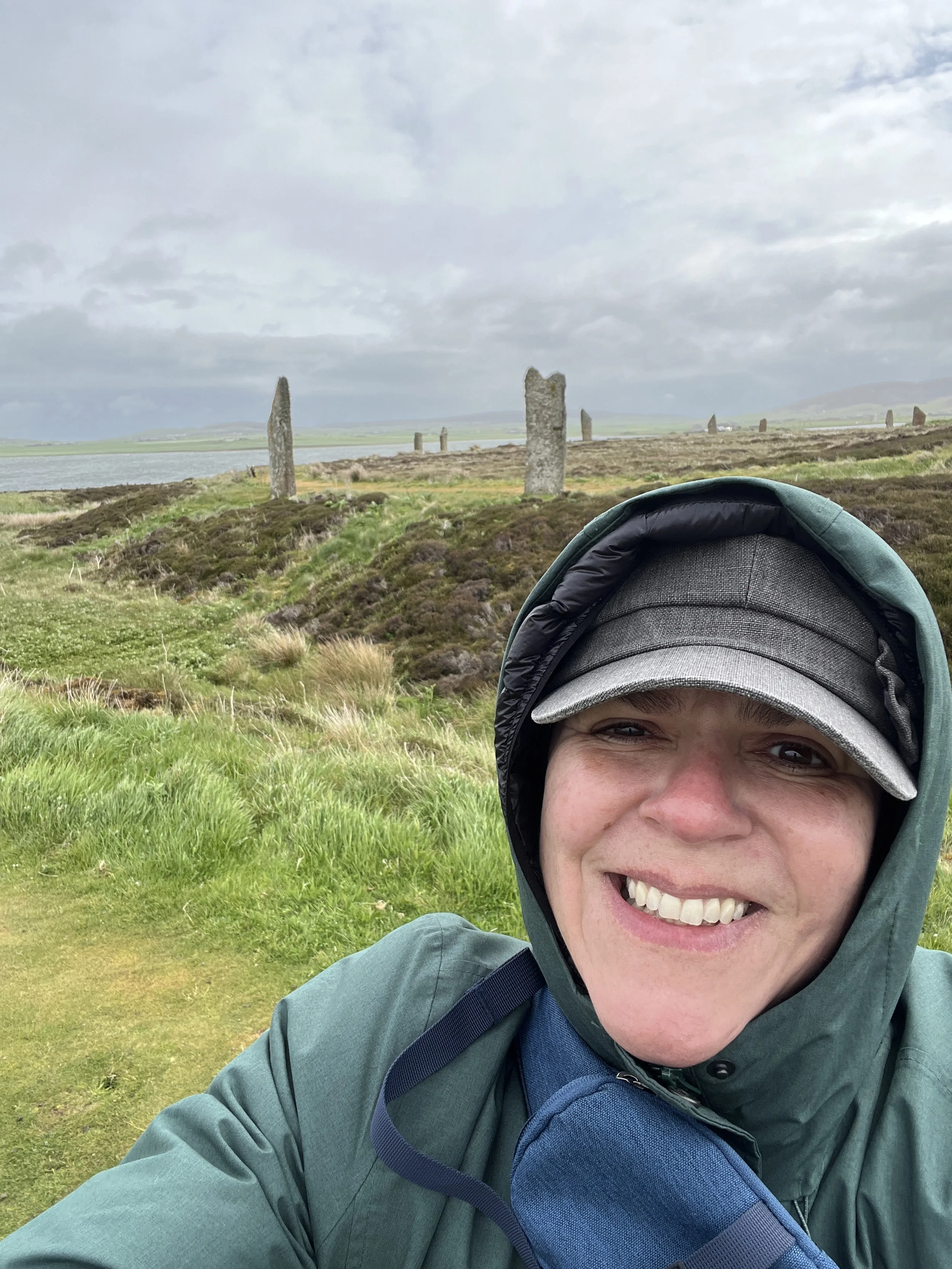
Windswept in the rain at the Ring of Brodgar Stone Circle and Henge
in Orkney, Scotland (2025)
Lineage
I came to these traditions the way I come to most things, by following my curiosity and my joys until they led me into the work of teachers who became companions.
I read their books, sat with what they were saying for as long as the books would let me, and then I digested what they were teaching in my own way until it came out the way I would say it.
Depth psychologyin the Jungian lineage is the floor of the work. I trained at Pacifica Graduate Institute, and the floor is real and load-bearing. James Hillman, James Hollis, Marie-Louise von Franz, and Edward Edinger are companions whose books live on my shelves and whose voices show up in my room.
In archetypal astrology, I read in the lineage of Liz Greene, Howard Sasportas, Brian Clark, and Alice O. Howell, among others. Howell brought the Jungian dimension fully into astrology for me. Greene and Sasportas built the synthesis of depth psychology and chart reading I learned to walk inside. Brian Clark has brought imagination, the weaving of myth with astrology, and a soulfulness to the work that I have come to think of as the missing ingredient in most contemporary chart reading.
Mythology runs underneath all of it. Greek and Roman myths have been my longest bread and butter. Celtic is my love and my strong resonance, and I am still deepening into it. More recently, I have been spending time with Nordic material. I follow the curiosity wherever she pulls me. Not to mention fairy tales, since Beauty & the Beast captured my soul as a child. And more recently, I’ve been focusing on the romance genre as medicine for these collective times.
I am doing slow solo study with the Druid Order, working my way through the bardic level. That practice has been transforming how I approach my work.
The bardic tradition is the part of my training most explicitly concerned with how stories carry medicine, and being inside it has clarified what I had been doing on my own for years.
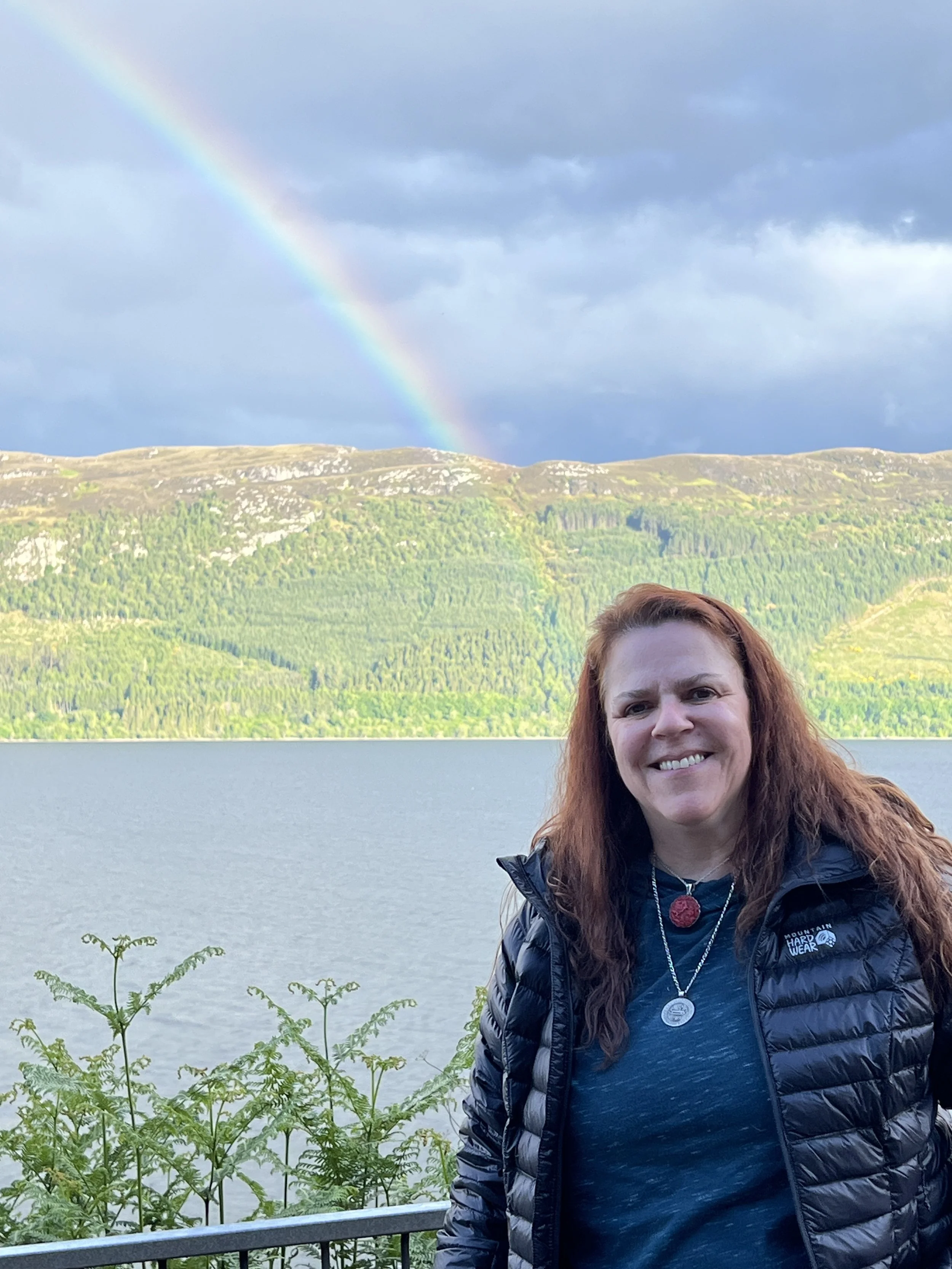
A welcoming rainbow upon arriving at Loch Ness, Scotland (2025)
Why I work the way I work
I believe in the sovereignty of the self. The work I do is not approaching a person as a diagnosis to be fixed or a problem to be solved.
The work approaches the person as a story that is unfolding, and that is asking something of her that will stretch her, grow her, and heal her in the older sense of that word, which means to make whole.
Healing in this sense is different from cure. It has to do with what is at the growing edge of who you are, and how to meet it.
I also believe that life, the cosmos, and the soul share a wise inner clock. They work together to invite us to grow past the limitations we have inherited or imposed, to live beyond the size we had agreed to fit. The cosmos is not a vending machine. The soul is not a project. They are more like the developmental editors of your story, asking the questions that move it forward.
So:
The work is not optimization, escape, or speeding through what is happening. It is reading what is in front of you carefully enough that you can meet it, and honor what it is asking of you. Most of the discomfort and challenge I see in client lives comes from not yet seeing what is being asked.
Astrology in my hands does not forecast. A birth chart and its transits are a sacred landscape, with parts of you asking to be recognized, honored, and brought into the room.
The approach is relational. You are not a victim of the planets.
You are invited to relate to them, even to romance them with the curiosity of lovers, instead of bearing them or barring them. The chart is not a forecast written in stone. It is the geography of a life you are the author of.
Threshold work is not therapy in the contemporary clinical sense, though it is therapeutic in the older sense of that word, which meant being in service of what is being called.
I do not tend the wound across years. I sit with someone at a threshold, listen deeply to what the next chapter of her life is asking, and accompany her through the crossing.
Virgil walked with Dante because Dante was new to that country, and Virgil had been there before. The work I do is closer to that than to anything else.
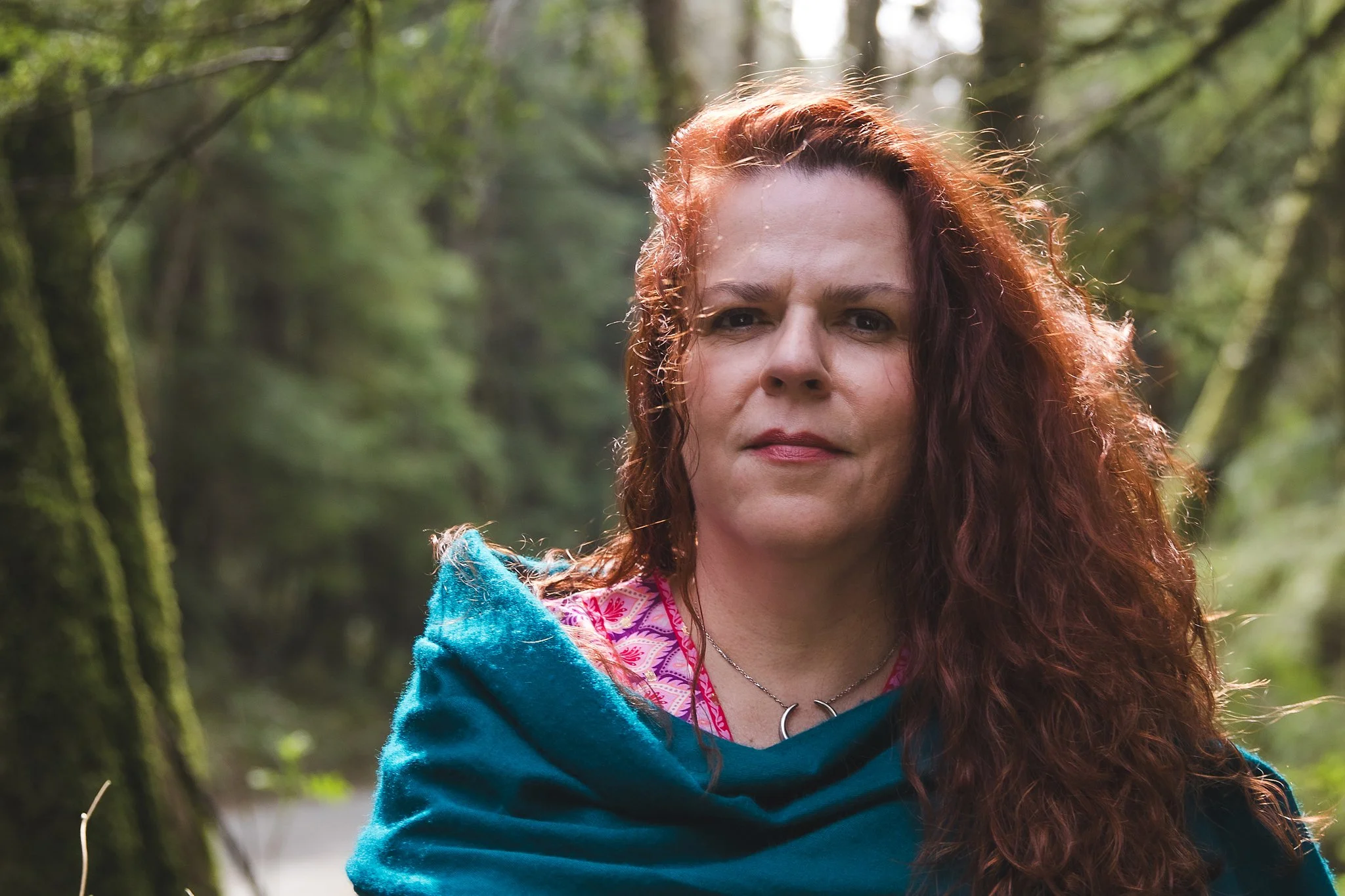
Bridge
If this is how you have been wanting to be read, the work is gathered around this site in several shapes.
A birth chart reading or astrology session for a focused question or a season.
Threshold accompaniment for someone in the middle of a real crossing.
The podcast, Romancing the Threshold, for when you want company in your earbuds while you walk through your own.
And the writing on Substack, where I think out loud about all of this with anyone who wants to read along.
Any of them is a way in.