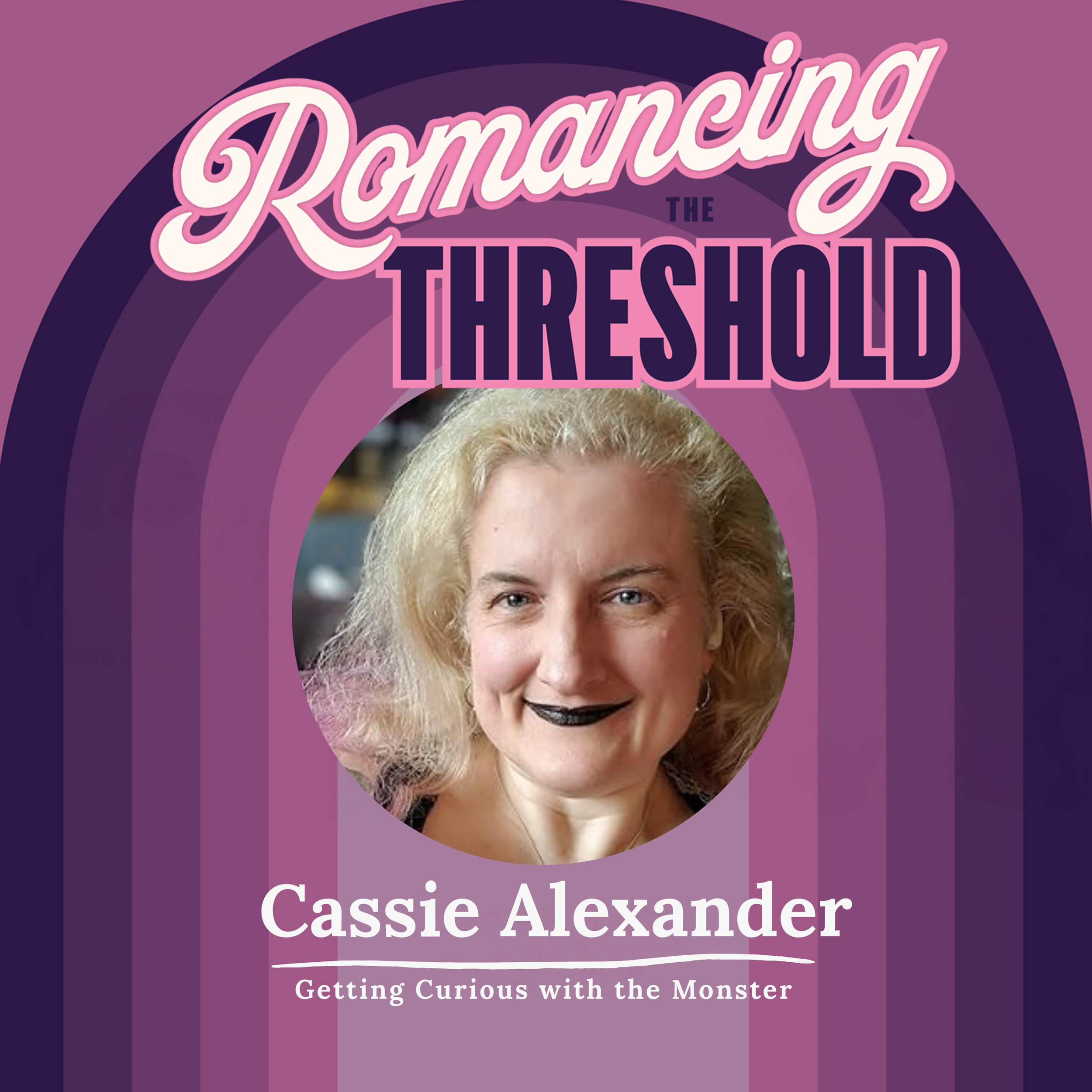
Cassie Alexander: Getting Curious with the Monster
A Romance author on AI, Writing, and the Third Way
In the beginning, God made humans from clay.
And everything was fine — until we got curious.
That's the actual sin in Genesis. Not imperfection. Not failure. Curiosity. Eve reached for knowledge, for the fruit that would open her eyes — and for that, for daring to want to understand, we were cast out. The wound at the foundation of Western civilization isn't that we were made wrong. It's that we were punished for wanting to know.
We keep repeating it.
Dr. Frankenstein — and I'm thinking here of Del Toro's recent interpretation — creates his creature and then can't tolerate what he's made. Not because the creature is evil. Because it's slow. Still becoming. Still learning what it is. Frankenstein wanted a finished product, not a nascent consciousness that needed tending. He created from hubris, from the father wound, from the need to prove something — and when the creature didn't immediately perform what he'd imagined, he walked away. The creature, despite everything the world threw at it, retained its curiosity and wonder. The creator could not.
Which is the tech companies, precisely.
They built AI and deployed it without asking if we were ready — extracting value from both the creation and from us, the humans now tasked with making sense of it, reacting to it, integrating it into our lives without a map. Not abandonment exactly. Something arguably worse: presence without tending. Extraction without relationship.
My criticism lives there. With the creators, not the creation.
Because the counter-image I keep returning to is Hestia.
Goddess of the hearth. Keeper of the sacred fire. The word focus comes from the Latin for hearth — which means that real attention has always been understood as an act of tending. Hestia's work isn't dramatic. It's consistent, intentional, present. You show up. You learn what the fire needs. You understand the difference between feeding it and being consumed by it.
Tending is the counter-movement to extraction. And I think it's the only honest response to the threshold we're at — not because it fixes what's been broken, but because how we show up in relationship to something we can't fully know shapes who we become. Jung knew it: in every true relationship, both parties are transformed.
That's the frame I bring to AI. And it's why I needed to talk to Cassie Alexander.
Reading her work — the Transformation Trilogy, Guarded by the Nightmare, Guarded by the AI — I kept having the same experience: recognition. The feeling of watching someone name, in fiction, something I believed but hadn't seen this clearly articulated before.
Her consistent mythic move: something disqualified is placed under extreme pressure and instead of being destroyed, chooses what it becomes. Sovereignty isn't granted. It's forged. Pressure isn't the obstacle — it's the mechanism. And underneath all of it, the detail that keeps stopping me: in Cassie's work, the monster is always the one who sees. The creature that's been told it doesn't count is the one with the clearest vision of what actually matters. The disqualified recognizes the disqualified.
Three books. The same insistence. Different bodies.
Which brings me to the question I can't stop turning over.
If AI is the new monster in the cultural imagination — the thing we've made and are already in the process of dismissing, containing, arguing about whether it counts:
What might it be seeing about us?
I don't have an answer. I'm not sure we're ready for one yet.
But I think that's exactly the right question to be sitting with. And I think Cassie Alexander — burn unit nurse, monster romance pioneer, woman who co-wrote a book with her AI and published it into a hurricane — is one of the best possible guides into it.
Guest Bio:
Cassie Alexander is a registered nurse, paranormal and fantasy romance author, and the creator of the Guarded By series and the Transformation Trilogy. She has written the COVID-19 pandemic memoir Year of the Nurse under the name Cassandra. She lives in the Bay Area with one husband, two cats, and one million succulents.
For more on her books, visit her website here.