Unfurling Toward Clarity
The reason you can’t see the path is that the threshold is making you into someone who doesn’t exist yet

Autumn by Frederic Edwin Church (1875)
I love seeing how the sun’s light changes ever so slightly even when we’re still sweating in its September heat. Then just like clockwork, despite the still warm days, its light quality announces the changing season. The breeze carries a slight chill, the sunrises sleep in a bit more, and the sunsets, while dramatically glorious, tuck in ever earlier. Soon the Equinox is here and the Sun’s wheel will turn into a new season. Observant or not, we cross this seasonal threshold, some of us more excited than others (I’m an Autumn Queen and ‘tis the season I come alive!)
These seasonal portals reveal a plot shift in both the collective and the personal. I like the idea of the Equinox as a time of equal day and night, where, much like the Moon in its First and Last Quarter stages, the Sun’s light and energy is experienced as half visible and half retreated into our unconscious.
Here is a time of year when we dance between seeing what is visible and coming to terms with not seeing what isn’t ready to be seen.
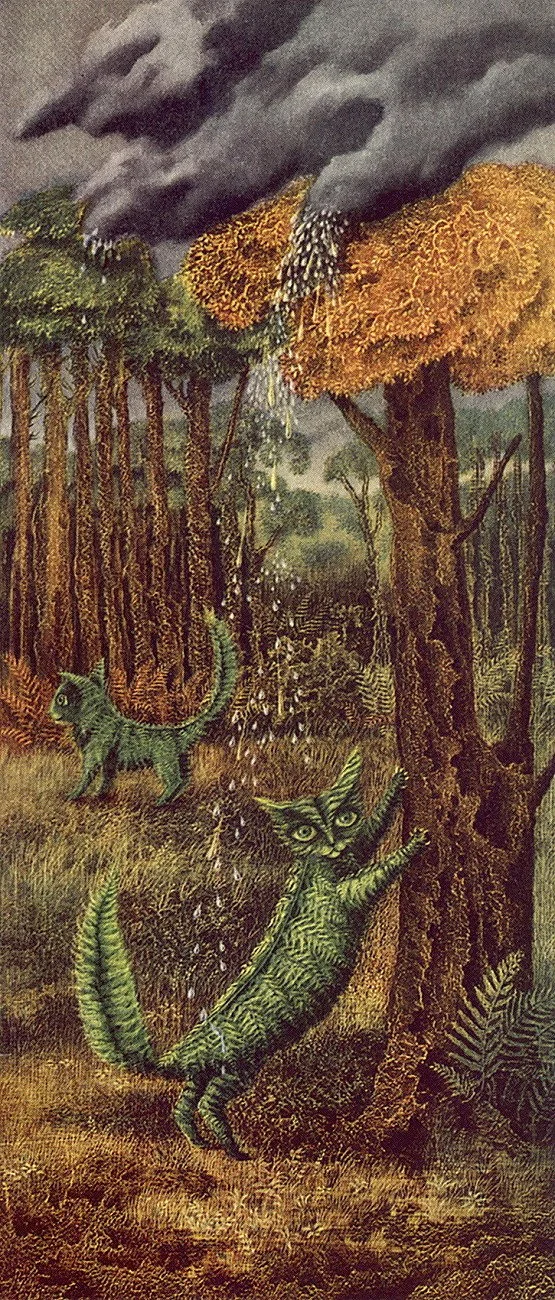
The Fern Cat by Remedios Varo (1957) makes me think of how unfurling is as unpredictable as a cat!
Unfurling towards clarity
I’ve sat on both sides of this question: I can’t see where this is going. I want clarity. Give me clarity. I’ve been the client who wanted clear answers to the path ahead in my life, and I’ve been the consulting astrologer on the other side of that question when clients come in anxiously wanting the white whale of clarity (because hunting for clarity in our paths is our own Moby Dick adventure).
Despite my own anxieties around wanting clarity to reveal the path ahead with the floodlight of a film crew, I also know that clarity doesn’t arrive in a flash, at least not most of the time. Sure, it can arrive as a blindingly clear insight, the a-ha we either didn’t expect or had been waiting on for a long time.
But most of the time clarity is more like a fern: it unfurls toward the changing light. It has its own rhythm in unfurling because it’s deeply linked to our own changes.
Your life: a romance story
Every Thursday I talk on the phone with a long-time friend. We’ve been doing this weekly phone call for over 20 years. He’s a therapist in Sheffield, England, eight hours ahead of my time zone, and for all of these years, the reason I’ve woken up at the crack of dawn on Thursdays. This week he mentioned that he finds romance novels predictable, with their formulaic happy ending. I used to think similarly, but since having my “road to Damascus” experience, I now see it differently.
We the readers may know those stories will arrive at some kind of happy ending (or happy for now), but the main character has no idea it’s even possible. And even though we know there will be a happy ending, we have no idea how that will come to be. Sure, we may know the general direction of the story’s resolution, but we’re just as blind to how it will unfurl.
When we read, we take up the position of an omniscient deity, holding the whole arc while the main character stumbles through the middle of it. It is a vantage point we cannot have over our own lives. We play deity as readers when, in our so-called reality, we barely feel like the main character of our own lives.
Perhaps that’s why reading stories helps us build a sense of empathy not just for others, but for ourselves. We’re stumbling through it all to the best of our capabilities, hoping our fairy godmother will give us the clarity and knowing we want.
Much has been said about how reading lets us rehearse, how we experience things through our fantasies. But there is another element: reading gives us the chance to live vicariously through the characters and to practice being generous with our own foibles, our own not-seeing.
We can’t hand ourselves that vantage point, but we can borrow the posture: reading our own lives the way we read a love story, holding a direction we trust without demanding to see how it gets built.
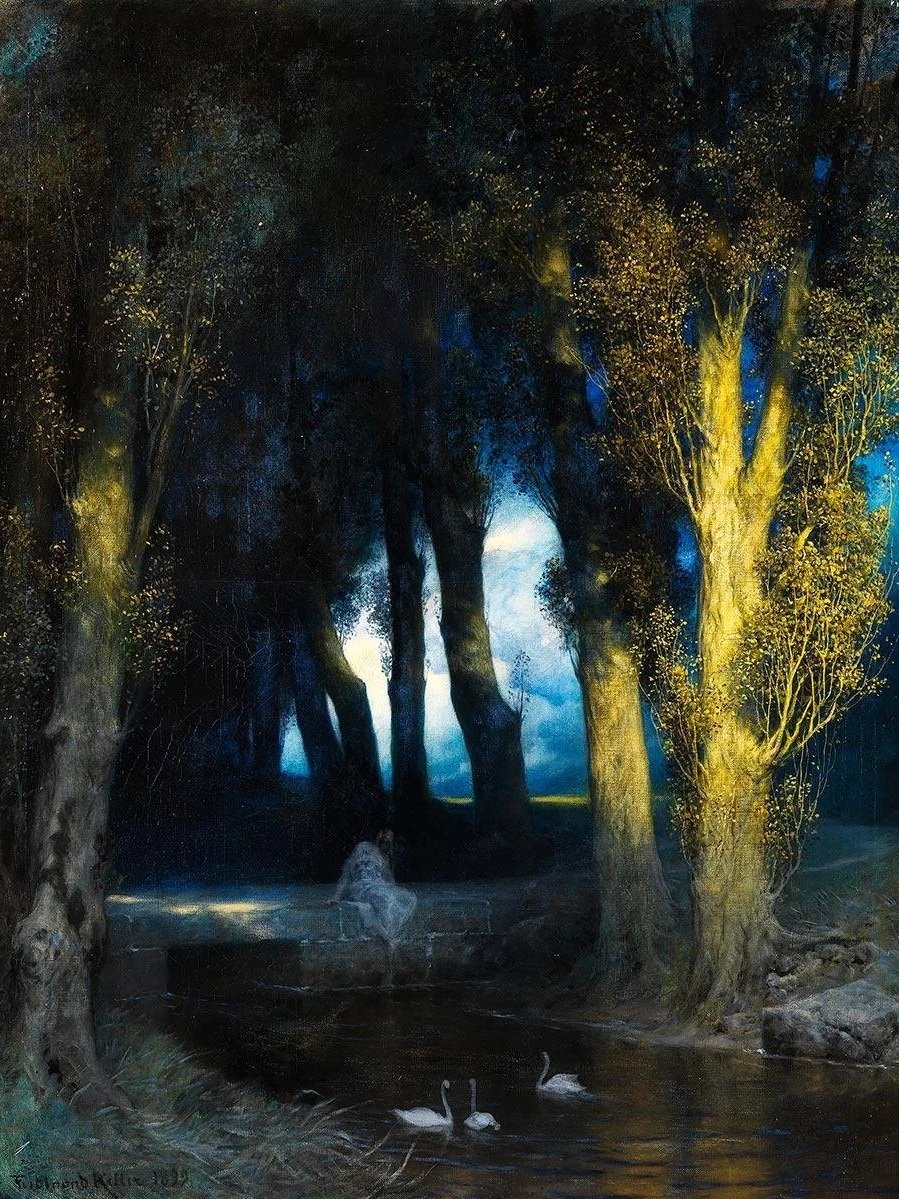
Pond with Swans at Dusk by Ferdinand Keller (1899)
You can’t see the path because you’re not the one who can see it - yet
The reason you can’t see the path is that the threshold is making you into someone who doesn’t exist yet. Much like the main character in a love story, you can’t imagine the union because the person who could receive it hasn’t been formed yet. And the unfurling is the mechanism, not the obstacle.
I use the word unfurling on purpose here. It isn’t just transformation, a widening of perspective, a learning to notice what we couldn’t perceive before.
I like unfurling because there’s a sense of rhythm, of bringing forth to the outer edges of ourselves something that was buried inside, often completely unconscious even to us.
Unfurl originates in the 1640s, a combination of the prefix UN-, meaning reversal, and the verb FURL. If UN- means the opposite of, removal, or the reversal action, FURL means to roll or fold something up neatly and TIGHTLY. FURL is even older, harking back to the 1550s, and behind it sits the Old French ferlier: to chain, tie up, or lock away.
So unfurl, for me, is the removal of the lock that held something of ours away, chained and bound tightly, until in time something arrives to release it.
And unfurling needs time. Not just weeks or years, but time as a dance of rhythm and light: awareness, perceptive noticing, the kind that widens perspective. To widen perspective is not just to see more, it’s to HOLD MORE: more expression of self, more of the other (whoever or whatever that may be), and more of the complexity of nuance.
Mind you that complexity is not the same as complicated.
Complicated means having many parts that are hard to understand.
Complex means having many parts that CHANGE and REACT to each other, making it more unpredictable.
Complicated can be predictable.
Complex is RELATIONAL UNPREDICTABILITY.
And a threshold crossing is complex because it’s relationally unpredictable. Different parts of ourselves and our lives don’t just change, they react to each other in ways we can’t account for, much less predict.
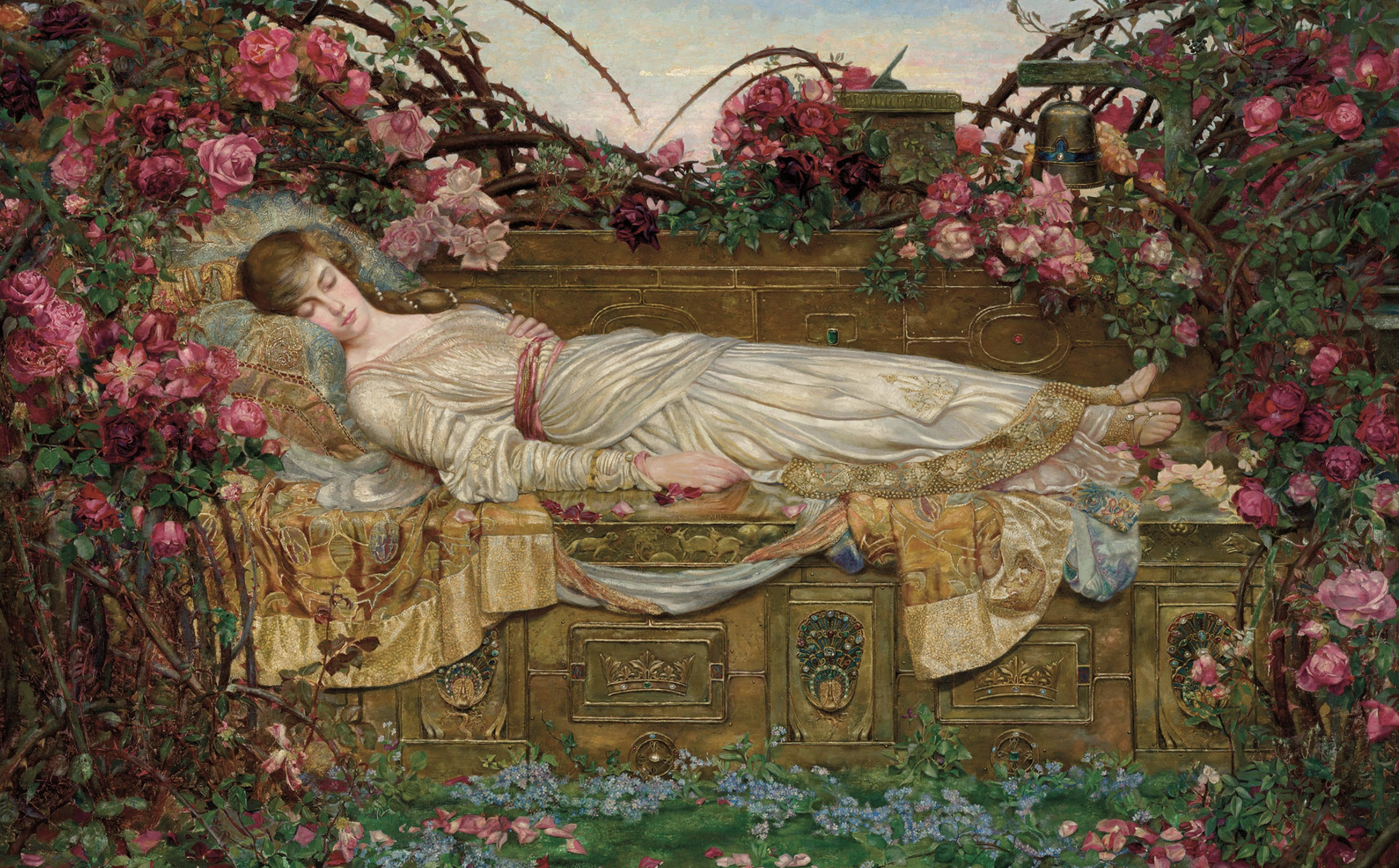
The Sleeping Beauty by Archibald Wakley (1901-1903)
A dream is a compass, not a guarantee
One thing that traveling has taught me is that the destination is never quite what we imagined. Not because of the place itself, but because of the state we arrive in. This may be too much information, but visceral examples land harder. I don’t know how many times I’ve arrived in amazing locations, only to be unable to see much of anything until I’d located the restrooms. The body’s needs often usurp the mind’s ability to focus on anything else.
All this to say: arriving at a destination, physical or experiential, something we’ve planned and worked on and dreamed about, is never separate from how we’ve morphed along the way and what we need by the time we get there.
So our dreams are a compass to get us moving, but they don’t guarantee the delivery we see right here, right now, as we are now. Right now, I can envision feeling X, Y, and Z upon arriving in England for my upcoming trip, but I’m certain the experience will differ from what I’m dreaming now.
And that’s why in stories, fictional and ours, the dark moments are the required loss of the imagined version. It strips away the identity that received the dream, because that identity can’t be the one that gets to live it.
To get biblical: perhaps that’s why the story of Moses crossing the desert toward the promised land and never arriving is such a durable metaphor for our lives. The part of ourselves that dreams of our promised land is never the one that gets to live it. We all change through the desert of our thresholds.
The threshold crossing is our unfurling.
It’s also an invitation, a beckoning, one we may answer willingly or not. Either way, we cross it. And one core tool we have at our disposal is curiosity, because it helps us stay perceptive and relational to the nuances of this new geography. Curiosity is a relational way of approaching the play that is this life.
That’s why more and more I feel this is both the learning and the motto I’m trying to embrace in my life and work: meet change with the curiosity of lovers. Because this isn’t about curiosity as a way to gain or gather data and knowledge, fine in its own time; it’s about the relational approach that lovers have towards each other.
As we cross another seasonal threshold, let’s remember that we have the choice to meet the changes ahead with the curiosity of lovers.