The Anchor in the Storm Archetype
What holds is not the grip. It's the give.
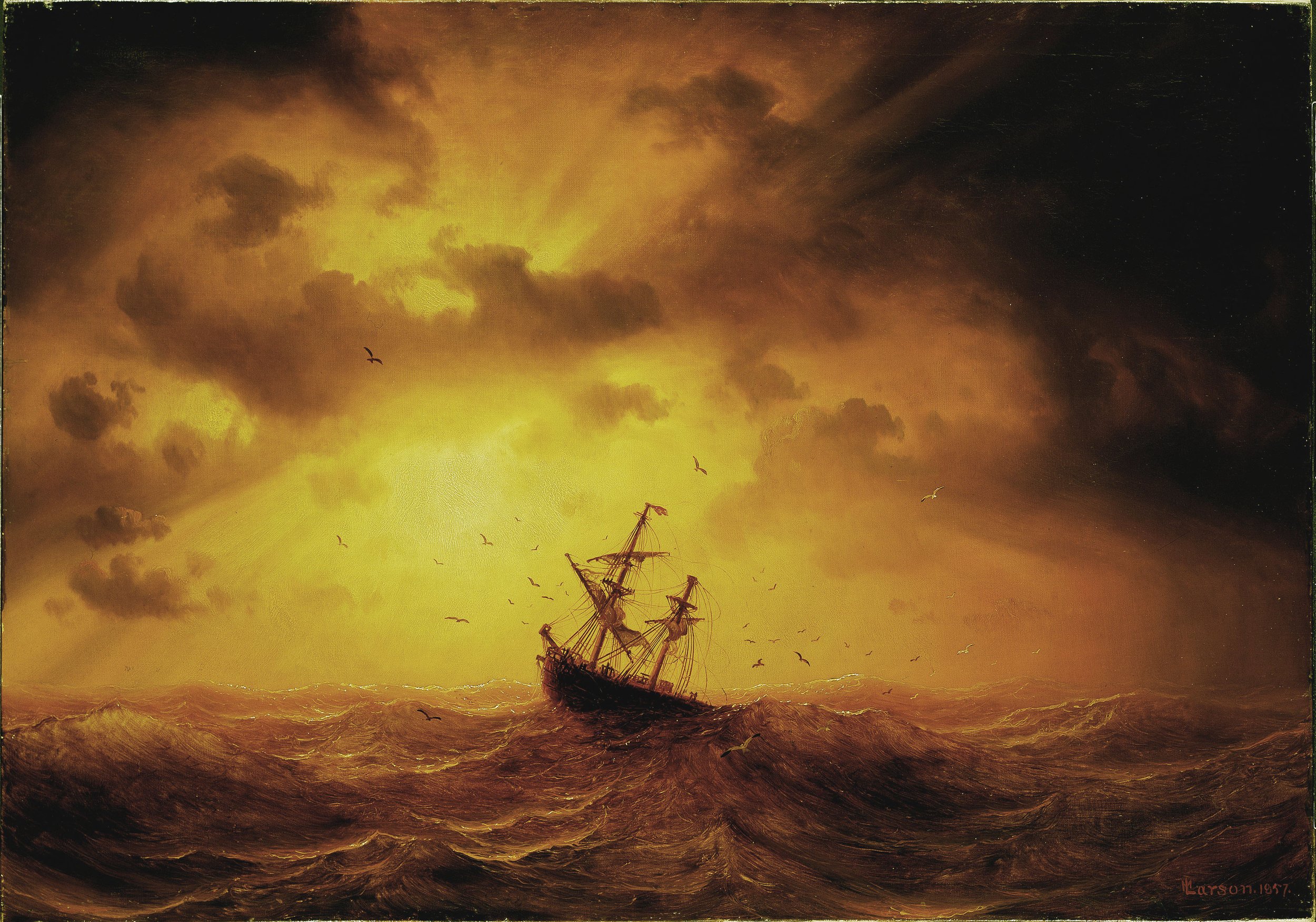
Stormy Sea by Marcus Larson (1857)
I believe we don’t have many issues in life. We’re not the trigger warning list, as we see in dark romance novels, as we’re made to think. I believe underneath the choppy waves of our lives is the core issue that permeates all spokes of our life’s wheel, making us think we have all of these issues, when in truth it’s just one: the core one.
And mine is faith.
I remember sitting at the pew as a child during Sunday mass, and praying to have faith, which even at a young age, I knew was something that I struggled with. I just couldn’t swallow what the Sunday school teacher would preach to us: have faith, faith is blind, faith is the mark of a true believer. All of that made me very anxious about the state of my soul, so I prayed to feel that faith that I saw my friends seem to have no issues with.
Then in my tweens I started feeling I was faith-resistant, perhaps structurally immune to it. While I could believe the pull and power of my imagination, the images that captured me, the allure of what was hidden underneath the surface, I felt faith was beyond me, because by then I had learned that white-knuckling was how I was making my way through the world. By my teens and young adulthood, I learned that I could trust my competence to climb down, but the faith that I would be caught if I jumped without preparation was foreign to me, until my mid-30s and honestly it’s still a work in progress.
Notice that I just used both words in one sentence and treated them as the same thing. I did that for decades.
Here’s how I’ve come to hold the difference, and this is my working definition, not a decree. Trust comes from the Old Norse traust: firm, solid, the same root as the word tree. It describes a property of the thing itself. Is it sound, will it take my weight. You test the branch before you stand on it.
Faith comes from the Latin fides, which also means trust, so these two are cousins and not opposites. But fides is the root of fidelity, of confide, of bona fide, and what it names isn’t the soundness of the other party. It names the tie between you.
Trust is a verdict you reach about something. Faith is a relationship you’re standing in.
So there I was in the pew, certain the fault was in me. I thought my lack of faith was a verdict I’d been issued defective, and everyone else had theirs. What I couldn’t see, and wouldn’t for a long time, was that I was already being held, in ways I hadn’t foreseen and couldn’t have arranged.
Competence made that harder to see, not easier. When the only thing you count is what you did yourself, you come out looking like the sole author of your own crossing. I thought I was steering the ship alone. I had to learn to see the anchor.
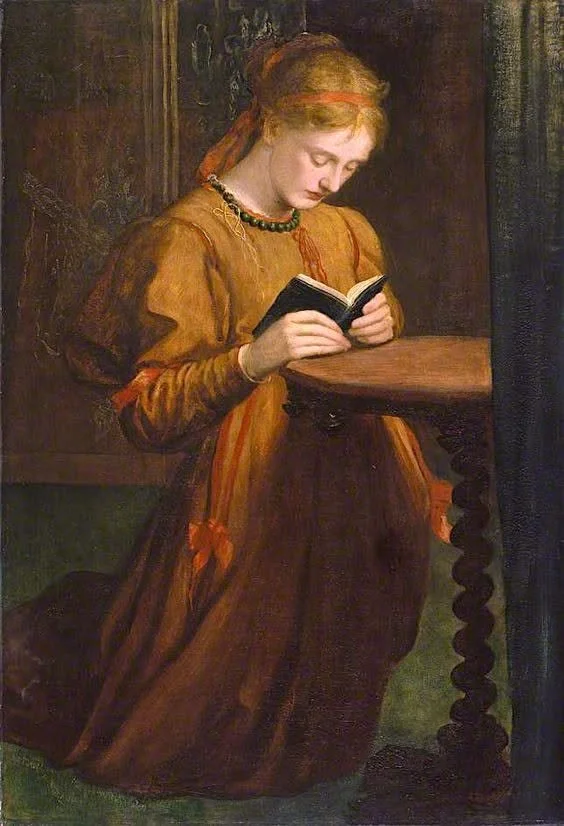
May Prinsep (aka Prayer) by George Frederick Watts (1867)
But why faith? Why now?
Since launching my Threshold Lover Quiz, I’ve been living with these eight archetypes that I created, channeled, called forth (all applicable depending on my mood!), much like I lived my thesis after I had written it. I have a propensity for creating the container and then inhabiting it.
So as folks are taking the quiz, I’m seeing which ones are climbing up the charts and which ones are lagging behind. It’s a curious snapshot, albeit small in terms of numbers, of what is up in the collective. I may not be writing about astrology as I used to do, but the astrologer in me is always looking for the larger picture, and has never left the room. It doesn’t take much to see how we’re living in the brackish waters between past-the-sell-by-date ideas that have been the consensus reality, and this interregnum reality with the seeds of ideas that are both fascinating and scary.
It’s also fascinating to me to wonder why the precursor or process of death is inherently woven with chaos. As if there’s a need to weaken the hinges that have held a worldview, a life, a phase from the scaffolding, the foundations that kept it up, and in doing so, the breakdown is more than release, it’s the space created for the new to reveal itself.
Nevertheless, I’ve been surprised by the Threshold Lover results, where the Anchor in the Storm has been by far the most common result. Granted, it’s still a small sampling as the quiz is gaining slow traction, but with the Shape-shifter being a distant second, I believe this says something about not just our times (insert the overused word unprecedented) but also how we’ve been taught through our culture to navigate change.
First the collective: at the end of 2019 I did a talk on the astrology of 2020 and I said we were coming into the Courageous Decade (you can watch my 4-part series here) and it would be all hands on deck. I said Courageous Decade, not because we inherently had courage, but because we would need to find it within ourselves.
And all hands on deck is best translated as in the cosmic potluck of now, anything you have to bring would be needed: be it casserole, tiramisu (who’s bringing that! Do tell!) or a bag of chips, all needed, all will be used!
And each year of this decade thus far has not held back any punches. It’s been bam, bam, kapow all the way, and there’s a sense of weariness, anger, frazzleness and apathy that reminds me of babies that need to take a nap, but can’t do so, thus they whine, fuss and cry.
I’ve thought about that talk often in the years since. It wasn’t a forecast. It was an image, and the image was already a ship: all hands on deck, weather coming. I’ve watched it unfold, and I’ve spent a good part of the time since teaching the cycles behind it, because understanding the shape of a period is different from bracing for it.
What I notice now, six years in, is how the old ways keep coming up short and how we keep reaching for them anyway. Short-term results. Quick fixes. Whatever gets us to the next quarter. None of it is built for a crossing this size.
Which may be why the older stories are surfacing again. Myth, fairy tale, and the one I keep returning to, romance. Not as nostalgia. As stories that move us toward what we want rather than away from what we fear, and that hand us back our appetite, which is no small thing in a moment this thick with chic pessimism and fashionable apathy.
The Threshold Lover came out of that. It grabbed me and I’ve been following it, seeing where it will lead and what shape it will continue to take.
My hope in creating it is that it offers a more relational way to meet change.
Since launching my Threshold Lover Quiz, I’ve been living with these eight archetypes that I created, channeled, called forth (all applicable depending on my mood!), much like I lived my thesis after I had written it. I have a propensity for creating the container and then inhabiting it.
So as folks are taking the quiz, I’m seeing which ones are climbing up the charts and which ones are lagging behind. It’s a curious snapshot, albeit small in terms of numbers, of what is up in the collective. I may not be writing about astrology as I used to do, but the astrologer in me is always looking for the larger picture, and has never left the room. It doesn’t take much to see how we’re living in the brackish waters between past-the-sell-by-date ideas that have been the consensus reality, and this interregnum reality with the seeds of ideas that are both fascinating and scary.
It’s also fascinating to me to wonder why the precursor or process of death is inherently woven with chaos. As if there’s a need to weaken the hinges that have held a worldview, a life, a phase from the scaffolding, the foundations that kept it up, and in doing so, the breakdown is more than release, it’s the space created for the new to reveal itself.
Nevertheless, I’ve been surprised by the Threshold Lover results, where the Anchor in the Storm has been by far the most common result. Granted, it’s still a small sampling as the quiz is gaining slow traction, but with the Shape-shifter being a distant second, I believe this says something about not just our times (insert the overused word unprecedented) but also how we’ve been taught through our culture to navigate change.
First the collective: at the end of 2019 I did a talk on the astrology of 2020 and I said we were coming into the Courageous Decade (you can watch my 4-part series here) and it would be all hands on deck. I said Courageous Decade, not because we inherently had courage, but because we would need to find it within ourselves.
And all hands on deck is best translated as in the cosmic potluck of now, anything you have to bring would be needed: be it casserole, tiramisu (who’s bringing that! Do tell!) or a bag of chips, all needed, all will be used!
And each year of this decade thus far has not held back any punches. It’s been bam, bam, kapow all the way, and there’s a sense of weariness, anger, frazzleness and apathy that reminds me of babies that need to take a nap, but can’t do so, thus they whine, fuss and cry.
I’ve thought about that talk often in the years since. It wasn’t a forecast. It was an image, and the image was already a ship: all hands on deck, weather coming. I’ve watched it unfold, and I’ve spent a good part of the time since teaching the cycles behind it, because understanding the shape of a period is different from bracing for it.
What I notice now, six years in, is how the old ways keep coming up short and how we keep reaching for them anyway. Short-term results. Quick fixes. Whatever gets us to the next quarter. None of it is built for a crossing this size.
Which may be why the older stories are surfacing again. Myth, fairy tale, and the one I keep returning to, romance. Not as nostalgia. As stories that move us toward what we want rather than away from what we fear, and that hand us back our appetite, which is no small thing in a moment this thick with chic pessimism and fashionable apathy.
The Threshold Lover came out of that. It grabbed me and I’ve been following it, seeing where it will lead and what shape it will continue to take.
My hope in creating it is that it offers a more relational way to meet change.
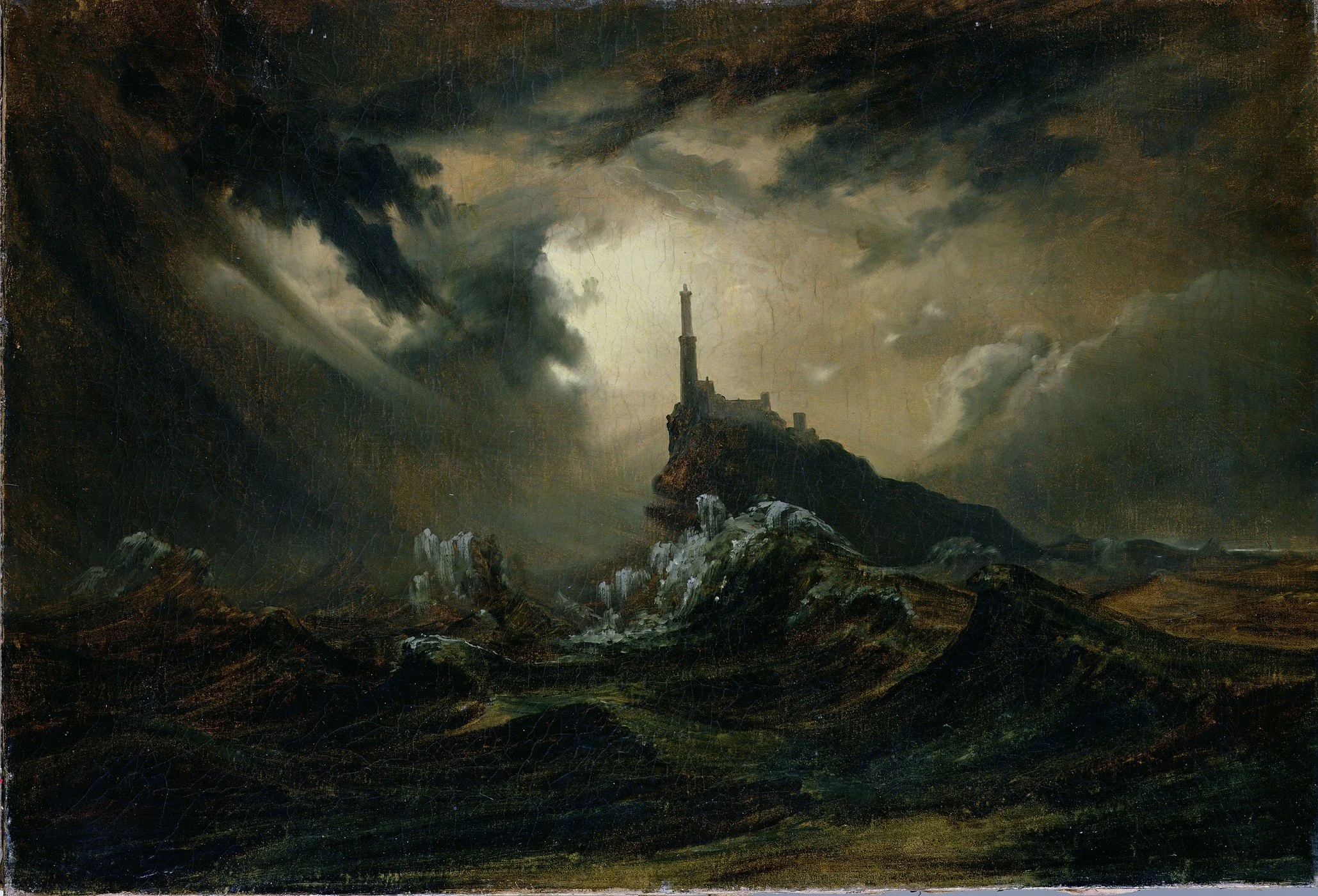
Stormy Sea with Lighthouse by Carl Blechen (circa 1826)
Why the Anchor in the Storm now?
Collectively, I have a couple of cents to share. (Well with inflation and cost of living, let’s make that a couple of quarters!)
When we hear anchor in the storm, most of us go straight to the person. Someone or something to lean into, to rest, to share the heavy load one is carrying. On the surface, yes, it can be that, and at times having that will be just the medicine for the moment. Finding this anchor in your life’s storm who will take the weight for a while, hold it, so you can breathe can be the difference between drowning and making it to shore.
A respite given by someone or something that holds the ground is a key to reaching the other side. It may not come in the ways you expect, but there’s no shame or guilt in wanting it. Any crossing will require rest and pausing and that’s part of the process, both individually and collectively. Thus now we’re all having to learn to find our rhythm between focusing on what’s happening out there, and then turning our attention towards what nourishes us, be that rest, play, community, silence, and the small pleasures of life.
But that’s the surface of the image. Underneath it is something harder to reach: faith not in a particular person, but in the larger unseen way we’re being held and carried, which we mostly cannot see and certainly did not arrange. That’s the part the anchor is actually pointing at.
And I think that’s why delegation gets stuck where it does. If the only anchor you can imagine is a person, then every act of trust has to be underwritten by somebody specific, and people are visibly fallible, and so back to the wheel you go. The person-level version can’t hold all of it on its own. It needs something underneath.
And delegation can be a bitter topic. Some thresholds are too intense for one to stop to articulate what they’d need doing. It would take more energy to explain, pass on the manual of how to do it, than to do it oneself. We’ve all been there, white-knuckling and straining ourselves all the way through. In a culture that has drilled into us that being self-made and independent is the heroic way through life, asking for help and (god forbid!) delegating, aka trusting someone else to do this part of the process for you, is betrayal to an identity. It’s also at times impossible, because the nature of what needs to be done requires you at the wheel. You’re the gladiator in the arena fighting the beasts.
And sometimes it’s none of those things. Sometimes it’s simply faster, the timing is genuinely wrong, and that’s the whole story. Not everything is a wound.
But there’s another version, and this one I know from the inside.
When trust isn’t there early, or isn’t there reliably, competence steps in.
You get very good at doing it yourself, because doing it yourself is the one thing that has never once failed to be available. It works. That’s the trouble with it. It works well enough and long enough that it stops being a way of coping and becomes a way of being, and then it becomes who you are, and by then nobody would think to question it, least of all you.
Which is why “just ask for help” lands the way it does. It sounds like a small request. It isn’t. You’re asking someone to set down the thing that got her here, in front of witnesses, with no guarantee anything else will hold.
So if you got Anchor in the Storm, I’m not here to tell you to ‘just rest’, ‘just ask for help’, ‘just delegate’. That’s where faith comes in.

Boats Carrying Out Anchors and Cables to the Dutch Men of War by J.M.W. Turner (1804)
The anchor, the chain, and the ground
The expression of anchor in the storm has a spiritual connotation meaning having an unshakeable inner stability, connection to the divine and (you guessed it) faith. Before we dig into faith, let’s work with the image first, starting with the anchor.
An anchor doesn’t hold by weight, it bites the ground beneath the storm raging above.
The real unsung hero in this image isn’t the anchor itself, but the chain, which is often heavier and longer, this is the key word, than the anchor itself.
The chain is longer because it affords a give. The slack lets the anchor pull stay horizontal, and not vertical, which could actually wreck the boat in half. So the extra length in the chain allows for shock absorption.
Also the type of anchor matters, because there are different types of anchors for different types of terrain. Each terrain will require a different approach to digging into it and the same anchor that worked before may not work in this new terrain. This drives the point that each threshold is a different one and the old tools may not work this time.
And each terrain has its own way of not holding, which is the part I find most useful. In sand an anchor sets well but can drag if it never bites deep enough. In soft mud it may not find anything solid to grip at all, so it sinks and holds nothing. On rock it either wedges hard or skates right over, and if it does wedge you may not get it back. Sand, mud, rock: different holds, and a different way of failing in each one.
Which is to say the question isn’t whether you have a good anchor. It’s whether you have the right one for the ground you’re actually in, and whether you know how this particular ground tends to let go.
A short taut chain will tend to pull the anchor out and drag the boat, and this shock can strain to the point of wrecking the boat. The key element to understand here is that the anchor in the storm doesn’t prevent motion. The boat will still swing, rise, fall and move. What the anchor prevents is drift, ending far from course, or even worse, being driven onto the rocky shores.
And drift is a quiet thing. That’s what makes it worth naming. It isn’t the storm, it isn’t the wreck, it’s the slow going-away from what you meant, and it doesn’t announce itself. You look up at some point and the shore isn’t where you left it.
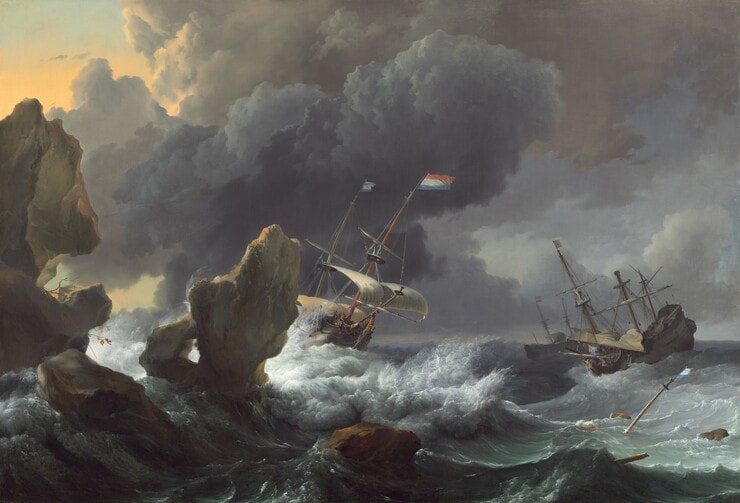
Ships in Distress off a Rocky Coast by Ludolf Backhuysen (1667)
What looks like looseness
Sit with the short taut chain for a moment, because it took me a while to see what it was describing. A chain pulled tight looks like the safer arrangement. It looks like the one that’s really holding on. It’s the one that rips the anchor out of the ground and can break the boat in half. What looks like looseness isn’t a failure of holding. It’s the thing that makes the holding work.
Which is to say: the white-knuckling I learned as a girl, the thing I’ve taken for competence my whole life, is the short chain. I’ve been gripping and calling it steady. What I’m learning now, and it’s slow, is to hold it lighter, and to stop mistaking the tightness of my grip for the soundness of the hold.
And here’s the figure inside all this tackle, the one the archetype is actually named for. The Anchor in the Storm doesn’t calm your weather. He doesn’t ask you to be steadier, or further along, or better organized before he’ll take hold. He isn’t waiting for you to stop thrashing. He’s already in the ground, and the swing is allowed. That’s the whole offer, and it’s stranger than it sounds, because most of what we’re handed at a crossing arrives with conditions attached: be calmer, be clearer, be ready. He has no renovation agenda. He holds while you are exactly as you are.
As I sit with this image, I feel the anchor in the storm, at a deeper level, is about faith. About something that can’t be seen, only felt or surmised.
Actually, the image splits the two words for me better than any definition could. The chain is the part you can inspect. You can haul it up, check the links, know what it held last time and how it behaved. The ground is the part you never see. You drop into it and either it bites or it doesn’t, and no amount of looking will tell you beforehand.
The chain is trust. The ground is faith.
Anchoring to what’s under the waves is anchoring to the unseen elements that guide our journey. It’s to have faith in something that isn’t seen with our naked eyes, or the eyes of our rational mind. It’s to place faith in the depths and the currents that really guide the entire journey, and not get caught or distracted by the waves and thunders of what is on the surface. In stormy weather, the surface becomes unreadable, hard to make sense of because it’s chaotic, noisy, and filled with drama. If we take this to our collective situation, we can all attest to this: the chaotic wind storms created by the slew of information that overwhelm our systems, making it impossible to digest, not to mention metabolize. This overwhelm to our senses doesn’t create trust, it drifts us off course from what might be the steady points of our lives: what we value, cherish, find meaningful and purposeful.
The anchor doesn’t work on the surface, on the waves. It reaches past the choppiness into the ground.
It harks back to something I have worked with clients so many times: don’t get caught in the details of the drama, aka the choppy waves, but go under the waves, towards observing the patterns, or the symbol, or the image of what actually matters.
We live in this culture that has become a list of all the bad examples of Gemini gone wild: information mistaken as knowledge, humans as data points to be extracted, and the facsimile vs the aliveness of the symbol.
Trusting the aliveness of something that isn’t or can’t be translated into data, information for our ‘rational’ minds to fabricate a sense of safety, requires faith in the unknown and unknowable. It’s a harder move to make in a culture that has deep roots in materialism, both as a philosophy and a way of living.
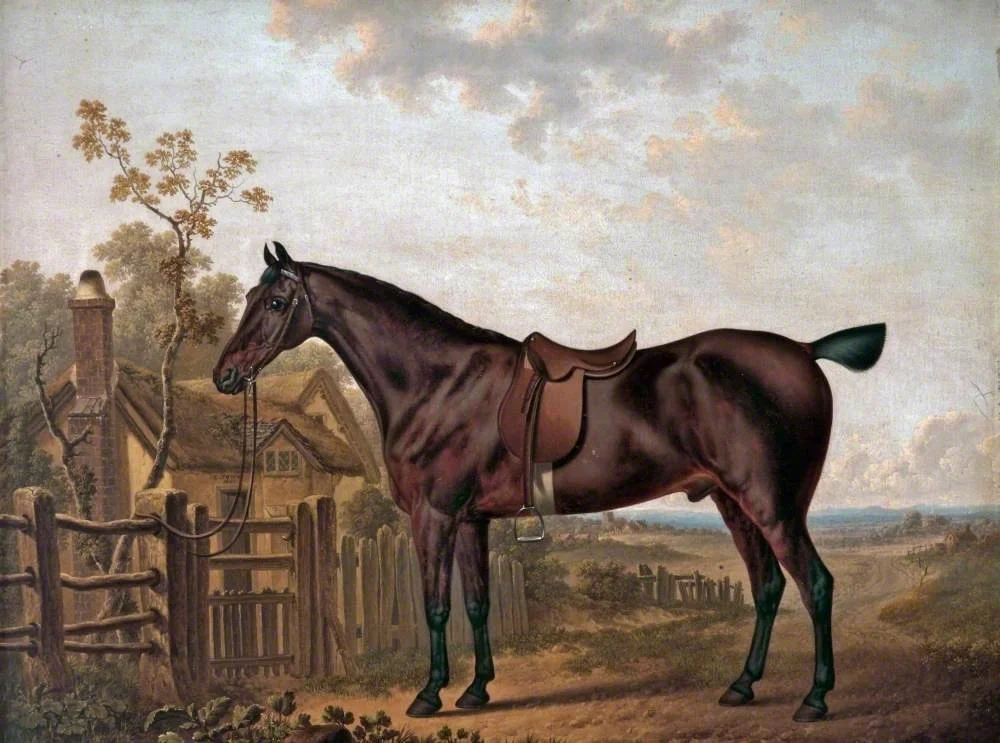
Saddled Bay Horse tied to a Cottage Gate by Charles Towne (1825)
Tie up your horse
And faith to me is about trusting the unseen, trusting that it will be there when needed, and it’s also about accepting that I’m not the sole driver of my life, call it providence, god, the daemon. Something else has input into my life and we’re co-writing this story together. For a kid that struggled with the concept of faith early on, it has been a one-sentence Sufi story that has helped me along the way: trust in Allah, but tie up your horse.
But I focused way too hard on the ‘tie up your horse’ as good daughters do.
A good daughter over-delivers on her half of the bargain. She does it because the other half was never reliable, so she compensates, and the compensating works well enough that she mistakes it for a philosophy. Competence became my substitute for faith. Not a bridge to it. A replacement for it.
I focused much more on doing my part and became quite competent, but that competency didn’t lead to the trust that I hoped for. It actually often made me drift off course, leading me closer to the rocky shores of worry, and to so much bracing and white-knuckling that to this day, when my shoulders and right arm hurt, I know it’s a sign that I’ve drifted.
My body registers the drift before my mind does.
The arm knows first. It always has.
It’s a work in progress and there have been many wins along the way that helped me to trust in the unseen realms, like now, where I’m trusting the aliveness of the image of the Threshold Lover.
And once, at the most depleted I have ever been, with nothing left to be competent with, something held anyway. I did not arrange it. I couldn’t have. That’s the closest I’ve come to the thing I was praying for in that pew.
Which is what makes me think the Anchor in the Storm isn’t in the business of handing anyone faith. Nobody has ever acquired faith by being instructed to have it; I have the pew to prove that. What he offers is repetitions. He holds, and then he holds again, and he holds while you swing and while you’re at your worst and while you have nothing to offer in return. That accumulation is trust, earned the only way trust can be earned, slowly and with evidence. And faith is what trust becomes when it stops needing the evidence in front of it every single time.
Trust is the ladder. Faith is what you can do once you’re up it. I was praying for the wrong thing in that pew, or rather I was praying for the right thing in the wrong order.
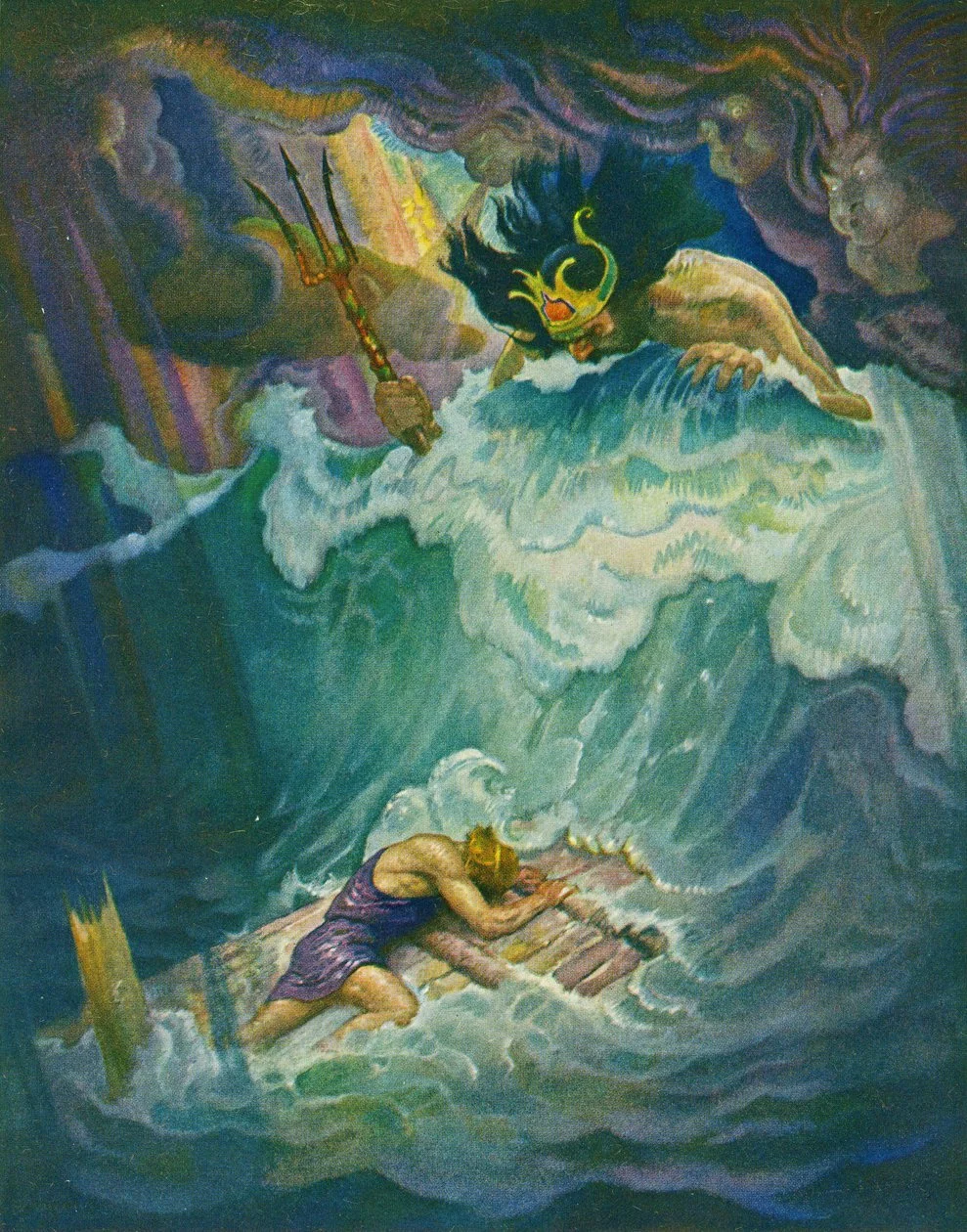
The Raft of Odysseus by Newell Convers Wyeth (1929)
If you have or haven’t seen Christopher Nolan’s Odyssey film, and any opinions aside about his interpretation of the ancient story, one image I invite you to hold: the scene of Odysseus’s simple raft bobbing alone in the Aegean sea, as he lies there half-dead, but surrendered to the god that he so angered, Poseidon/Neptune. For me that scene was the image that did it: away from the hubris of being the leader, being the driver of it all, but now a man surrendered to something bigger than himself. Not doing, letting it be done. Ironically, astrologically, I’d say this is one of Neptune’s hardest lessons: surrender.
Like the Hanged Man in the tarot, being held upside down so that you can gain a different perspective.
To me that’s what faith does: it’s a surrender and a different perspective that shows us that we’re not in control, not in this materialistic check-list manner, but that we’re co-writing, co-creating with something other.
Perhaps this is the toughest lesson of the Anchor in the Storm: to trust and surrender to something unseen that lives under the waves and isn’t interested in our rational drives. It’s a reminder that this life, while physical, is also ephemeral. We can’t just claim the poetics of ‘we’re made of stardust’ and then not trust the stars.
If you’ve taken the Threshold Lover Quiz and got this result, I can’t speak to your individual reasons for getting it, but I’m curious how it resonates with you, and a little about the threshold you’re standing in, if you’re willing to share. Drop me a line.